• Document No: 0001
  • Issue Date: November 2023
  • Revision No: 03
  • Revision Date: 01.10.2025
  • Page No: 3 / 9

SUSTAINABILITY MANAGEMENT

  • Management System

  • Legal Compliance

  • Stakeholders and communication

  • Accessibility

  • Purchasing (or Procurement)

  • Cultural Sustainability Policy

  • Energy and environment

  • Water management and wastewater

  • Food waste and solid waste

Management System

This document establishes the fundamental framework and sets out the policies for a Sustainability Management System (SMS) that can be adapted and developed to encompass all management processes of our hotel. This document is prepared for the hotel’s management and personnel. Our system is developed to be appropriate for the size and scope of our hotel.

The foundation of our management system rests on risk analysis. Risk analysis is conducted across the categories of environment, natural disasters, society, culture, economy, quality, human rights, health, and safety. New categories can be added if necessary.

The Sustainability Management System involves the implementation of specific policies by all employees concerning quality, economy, management, environment, culture, human rights, health, and safety, the setting of objectives, and the continuous improvement of business management processes by monitoring the attainment of these objectives.

When the defined objectives are met, new objectives are set. If they are not met, our objectives, policies, and practices are reviewed. By doing so, we strive to ensure continuous improvement.

The objectives and performance indicators used to monitor compliance with these objectives, related to our hotel’s management system, are included in the annex of this document.

Our hotel’s objectives and performance indicators are presented in Table-1.

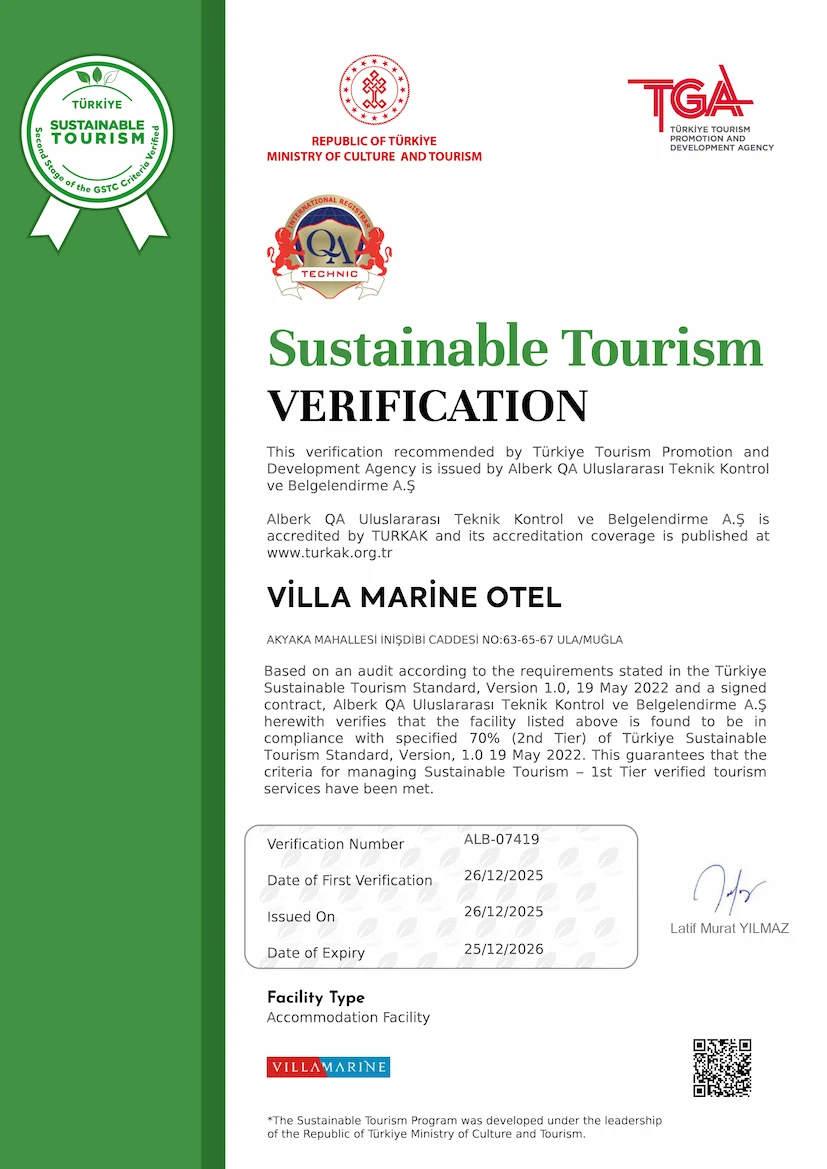
Regarding sustainability, our hotel is committed to fulfilling the Phase One obligations of the Türkiye Sustainable Tourism Programme and to the continuous improvement of the sustainable management system to enhance sustainability performance.

Our management system is continuously reviewed, and the system and policies are updated when necessary, due to the status of the sector, environmental, social, technological, economic, and cultural risks, and changes and updates arising from legislation.

These steps can be summarized as the Plan-Do-Check-Act (PDCA) approach (Figure 1).

  • Plan: Our hotel prioritizes and sets objectives regarding the environment, society, culture, national economy, and management system. It plans the roadmap and actions to be followed to achieve the determined objectives.

  • Do: Our hotel defines its core environmental, cultural, social, human rights, health, and safety policies and practices. It monitors, measures, and records these at defined intervals by the relevant personnel.

  • Check: Feedback from both personnel and customers in our hotel is monitored and recorded. Corrective actions are taken if necessary.

  • Act: This is the step where our hotel takes action to rectify the problems identified in the check step. Corrective measures and actions are recorded and archived.

Legal Compliance

Our hotel is committed to complying with current laws, regulations, and international agreements, maintains an updated list of these, and regularly informs and provides the necessary training to our personnel regarding them.

The key legislation to be complied with is detailed in Table-2.

Upon request or demand for submission, our hotel shall present all necessary permits, certificates, and documents to the relevant persons and institutions.

These documents include the Simple Accommodation Tourism Business Certificate, Business Opening and Operating License, personnel insurance declaration for the last month, tax plate, personnel training records and certificates, pool water measurement and control documents, pest control documentation, and other required documents.

Stakeholders and Communication

Our hotel provides accurate information to all segments of the public in its promotional activities. We always use authentic visual materials in promotions. Our hotel adopts a transparent and realistic structure regarding its products and services in its website, social media accounts, and other printed and written promotional and marketing communication channels.

Our hotel also shares its policies and sustainability activities, actions, and processes openly and transparently with its employees and customers. For this purpose, we use announcement materials in our rooms and our website. We will begin publishing periodic reports on sustainability performance on our website.

An example of performance reporting is provided in Table-3.

Our hotel has a system aimed at receiving feedback regarding our sustainability performance, policies, and practices from our customers, public institutions, municipalities, employees, local community, and all other relevant individuals and organizations. Through this system, we receive feedback from both our personnel and our customers.

Our system is designed to enable and encourage our customers and personnel to provide feedback quickly, simply, and effectively. This system includes customer surveys, regular monitoring of social media accounts, all communication channels for employees, and email communication and its regular follow-up for all other stakeholders.

Customer Experience: Customer satisfaction is important at our hotel. Customer satisfaction includes feedback received from the sustainability system described above. The results obtained are analyzed. Negative feedback and the responses given are recorded, and necessary measures are taken.

Staff Participation: The most important element of our hotel’s management system is our employees.

Our employees know what they need to do regarding our management system and our sustainability policies and practices. The responsibilities of our employees are defined in writing, communicated to them, and necessary training and guidance are provided regularly. Training on this subject is recorded.

Our employees take an active role in the development and continuous improvement of our management system and sustainability performance. We review and improve our system based on feedback received from our employees.

In line with our sustainability policies and management system, we provide periodic training programs, on-the-job training, legally required training, and guidance support to employees concerning sustainability and their areas of work, including orientation training. We implement annual training plans covering topics such as Occupational Health and Safety training, hygiene training for kitchen/service personnel, water and energy saving, chemical usage rules, fire protection, first aid, etc.

Our employees have free and open access to all our training materials.

Our Training Tracking Form is included in Table-4.

Our hotel is committed to complying with the relevant provisions of Labor Law No. 4857 and pays employees at least the minimum wage. Additionally, our hotel is committed to compliance with Social Insurance and General Health Insurance Law No. 5510 and Occupational Health and Safety Law No. 6331.

Our hotel has established a “Sustainability Team” to manage sustainability activities.

The task distribution of the Sustainability Team is provided in Table-5.

Accessibility

Our hotel is committed to providing accessible tourism services for everyone within its means, and openly and accurately informs its customers and stakeholders about its accessibility level via its website.

Furthermore, our hotel is committed to ensuring full compliance with legal regulations concerning accessibility and pursuing and committing to continuous improvement in this area.

We strive to make continuous improvements not only for guests with physical disabilities but also for those who cannot participate in tourism activities due to visual, auditory, or other impairments.

Purchasing

Our purchasing policy includes policies aimed at local, environmentally sensitive, fair-trade based, and efficient purchasing.

Our sources of goods and services are monitored by our hotel. We hold discussions with our suppliers at defined intervals and check their sustainability certificates, information, and documents. We inquire about the Safety Data Sheets (SDS) of the products.

Local Purchasing: Our hotel prioritizes local suppliers when purchasing goods and services, provided they are quality and reasonably priced. For this reason, it regularly audits its suppliers, updates its supplier list, and informs its suppliers. The ratio of goods and services purchased from the local community has started to be measured.

Our hotel also prioritizes fair trade suppliers for imported products when purchasing goods and services, provided they are quality and reasonably priced.

Environmentally Sensitive Purchasing: Our hotel follows an environmentally sensitive policy in purchasing; emphasis is placed on efficient purchasing to reduce food and solid waste, energy saving, and water conservation.

Our hotel prioritizes environmentally friendly products (eco-labeled products) in its purchases. If eco-labeled products are not available in the product group to be purchased, it selects the relevant products from suppliers and producers whose production and all other processes do not harm the environment.

Within this framework, our hotel prioritizes the selection of suppliers with sustainability certifications when making purchases. Example certifications that may be sought in suppliers include ISO14001, ISO50001, ISO14064, and ISO20400.

Eco-certified (FSC, MSC, EU-EcoLabel, etc.) or traceable source products are preferred for wood, fish, paper, and other foods.

Threatened species and species whose sale is prohibited (fish, trees, plants, game animals, etc.) are not purchased or used in our hotel.

The ratio of our purchases from eco-certified, local producers and suppliers, and fair trade suppliers to our total purchases is being measured.

Our hotel has objectives related to purchasing eco-certified, local, and fair-trade products. Within this framework, we aim and pay attention to increasing the ratio and number of local and fair trade suppliers in our purchases.

The Supplier Evaluation Form is included in Table-6.

The Approved Supplier List is included in Table-7.

Efficient Purchasing: Our purchasing policy favors reusable, returnable, and recycled goods.

Our hotel also prioritizes bulk purchasing and the purchasing of bulk products. This results in fewer deliveries to our hotel and less greenhouse gas emissions.

Our fundamental priority and preference is that the products delivered to our hotel do not have unnecessary and excessive plastic, nylon, paper, glass, or wooden packaging.

In the purchasing of consumables and amenity products, we avoid single-use products and unnecessary packaging (especially plastic). We monitor the purchase and use of consumables and single-use products.

Table-8 is used to track single-use, plastic, and packaged products.

Cultural Sustainability Policy

Presentation of Cultural Heritage: Our hotel respects the intellectual property rights of the local population.

Authentic elements of traditional and contemporary local culture are utilized in our cuisine, design, and decoration.

Artifacts: Our hotel does not buy, sell, mediate the trade of, or display historical and archaeological artifacts.

Promotion of Sustainable Local Gastronomy: Our hotel prioritizes the promotion and consumption of local products. It puts forward innovative and creative practices to ensure sustainability in gastronomy across all its activities.

Energy and Environment

Energy Saving: Our hotel has an energy saving policy. The policy includes the regular measurement, monitoring, reduction of energy consumption, and the use of renewable energy.

Our hotel prioritizes the use of renewable energy as much as possible.

Our hotel groups energy consumption by energy type, and the energy consumption of different units is monitored.

The total energy consumed in our hotel is measured. The annexed table is used for measurement. The energy obtained by our hotel from renewable sources is monitored.

Table-9 is used for tracking electricity consumption.

Our hotel identifies activities with high energy consumption, plans and implements corrective measures to reduce energy consumption in these areas and activities (thermal insulation systems, preferring devices with a low energy consumption class, using LED bulbs instead of high energy consumption lighting like incandescent bulbs, etc.). Furthermore, our hotel uses energy-efficient equipment.

Our hotel informs and trains its employees and stakeholders regarding energy saving.

Water Management and Wastewater

Our hotel has a water conservation policy. Our policy includes the regular measurement, monitoring, and reduction of water consumption.

The water risk status in the region where our hotel is located has been determined. The Water Risk Atlas prepared by the World Resources Institute is used for this purpose. The link to the relevant website is provided here.

Water risk is separately assessed in the risk analysis, and a water management plan has been created. This plan includes targets and reporting for the measurement and tracking of water use and the reduction of water consumption.

Marine and lake organisms are not harmed by our hotel’s water usage activities. Nevertheless, the possibility of harm to these organisms has been assessed in the risk analysis, and necessary precautions have been taken.

Our hotel complies with all legal requirements and regulations regarding water usage. Our water comes from the municipal network or permitted well water.

We measure our water consumption. We calculate and report the total water used per guest or per overnight stay.

Table-9 is also used for measuring water consumption.

We have targets for reducing water consumption. To this end, our hotel plans and implements corrective measures. Water-saving equipment is used in our hotel. We have good practices in place, such as changing sheets and towels upon guest request.

Our hotel informs and guides its employees and stakeholders on water conservation. Our hotel mobilizes all its resources to ensure that wastewater does not harm the environment.

Regulations set by the local administration are followed for the disposal of wastewater. Legal requirements are complied with in this regard.

Food Waste and Solid Waste

Our hotel has a Solid Waste Management Plan. The plan includes the regular measurement and monitoring of waste generation, waste reduction, reuse, recycling, and waste disposal.

Table-10 is used for waste tracking.

Solid waste is segregated by type, such as food, recyclable, toxic/hazardous, and organic; recycling and reuse possibilities are considered during segregation.

Our hotel regularly informs and guides its employees and stakeholders on waste management using various visual and communication materials.

Solid waste segregated by type in our hotel is collected by authorized and licensed companies.

Our hotel has also identified activities with high solid waste generation and risk areas. It plans and implements corrective measures to reduce food waste and general waste.

The goal is to ensure that solid waste disposal does not have a negative impact on the local population or the environment. Compliance with the “Zero Waste Regulation” legislation regarding solid waste management is ensured.

Figure 1. PDCA Cycle